Defaults, fallbacks and priorities
Where an effective value comes from when several places can set it.
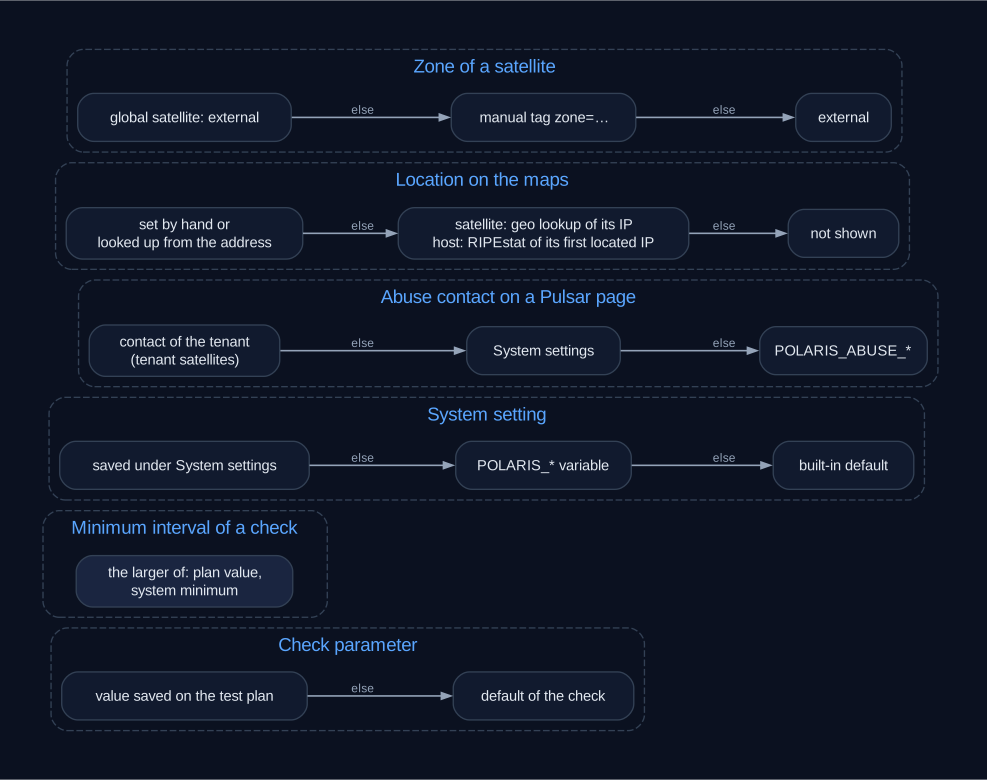
System settings vs. environment
For every setting a super admin can save under System settings: saved value → .env variable → built-in default.
| Setting | Saved in UI | Environment | Built-in |
|---|---|---|---|
| Interval defaults for new plans | Defaults for new plans | POLARIS_DEFAULT_INTERVAL_* | see below |
| Minimum interval per check | Minimum interval | — | 0 |
| Abuse contact | Abuse contact | POLARIS_ABUSE_* | none |
| Mail server | Mail server | MAIL_* | — |
| Address lookup | Address lookup | — | Nominatim, public server |
| Require TOTP | Sign-in | — | off |
Check parameters
A plan stores its parameters when it is saved. At run time: plan value → default of the check (all defaults). Two values are adjusted by Polaris before the plan reaches a satellite:
- Test access without a password (
detail_no_auth) is forced off for satellites in zoneexternal. - Automatic follow-up plans always use discovered ports only.
Minimum intervals
The effective at most every N minutes of a check is the larger of the plan’s value and the system minimum of that check. 0 means every slot. The prefill of new plans comes from the system defaults (never below the minimum):
| Check | Default (minutes) | Variable |
|---|---|---|
ping | 0 (every run) | POLARIS_DEFAULT_INTERVAL_PING |
traceroute | 60 | POLARIS_DEFAULT_INTERVAL_TRACEROUTE |
nmap | 60 | POLARIS_DEFAULT_INTERVAL_NMAP |
http | 0 (every run) | POLARIS_DEFAULT_INTERVAL_HTTP |
https | 0 (every run) | POLARIS_DEFAULT_INTERVAL_HTTPS |
cert | 360 | POLARIS_DEFAULT_INTERVAL_CERT |
smtp | 60 | POLARIS_DEFAULT_INTERVAL_SMTP |
ftp | 60 | POLARIS_DEFAULT_INTERVAL_FTP |
details | 360 | POLARIS_DEFAULT_INTERVAL_DETAILS |
reach | 60 | POLARIS_DEFAULT_INTERVAL_REACH |
dns | 60 | POLARIS_DEFAULT_INTERVAL_DNS |
mail | 360 | POLARIS_DEFAULT_INTERVAL_MAIL |
Targets a satellite gets
A plan’s targets are filtered per satellite, in this order:
- only target types the check supports,
- hosts expanded to all their addresses (unless Check every known address is off),
- for global satellites: no private addresses,
- no addresses of an IP family the satellite cannot reach (IPv4-only / IPv6-only); unknown connectivity counts as reachable,
- for follow-up checks: the ports discovered by the last port scan of that satellite.
Plans of a product the tenant has switched off are not sent at all.
Zone of a satellite
Global satellite → external. Tenant satellite → its manual tag zone=<name>, else external. Tags from the container (PULSAR_TAGS) cannot set the zone.
Location on the maps
Set by hand (coordinates typed or looked up from the address) → automatic (satellite: RIPEstat location of the address it connects from; host: RIPEstat location of its first located public IP) → not shown.
Abuse contact on a satellite page
Tenant satellite with an own tenant contact → System settings contact → POLARIS_ABUSE_*.
Mail delivery
Notification channel with its own SMTP server → System settings mail server → MAIL_*. Reports use the tenant’s SMTP channel if it has its own server, else the same fallback.
Hostname for TLS checks on an IP
Known hostnames of the host (each one as SNI) → confirmed PTR name → none (chain checked, name not checked).
Port closed
A port counts as closed after 2 scans in a row miss it from the same satellite. A policy violation needs 2 scans in a row that see it.
Languages
User’s choice (My account or footer) → browser language (German or English) → APP_LOCALE. Finding titles, satellite logs and report contents are stored data and stay in English.